
Compare the forming routes
Screw Flight Selection Guide
Compare cold-rolled continuous, mould-wound and sectional screw flight routes using geometry, material, length and production needs.
First collect the geometry
Prepare the outside diameter, inside diameter, pitch, thickness, hand and required finished length. State whether the values are nominal, measured from a worn sample or taken from an approved drawing. For sectional work, include the number of segments and how they will be joined. For continuous flight, include the required supplied length and shaft arrangement.
Cold-rolled continuous flight
Cold rolling progressively forms flat strip through dedicated rollers. It is commonly reviewed for continuous conveying or mixing flight where repeatable geometry along a length is useful. The practical range depends on the combination of strip width, thickness, ID, OD, pitch and material—not one maximum value considered alone.
Choose this route for review when:
- The flight should be continuous rather than assembled from individual segments
- The required section fits an available rolling range
- Repeatable pitch and diameter along the supplied length are important
- The material and quantity suit continuous production
Mould-wound continuous flight
Mould winding forms strip around a spindle and tooling arrangement. It provides a continuous flight with inner and outer edge thicknesses that remain closer than a tapered cold-rolled section. Tooling is linked to geometry, so the required section and quantity should be reviewed together.
Choose this route for review when:
- Continuous length is required
- Near-equal thickness across the flight width matters
- The geometry is suitable for spindle and mould forming
- Tooling requirements are acceptable for the order quantity
Sectional flight
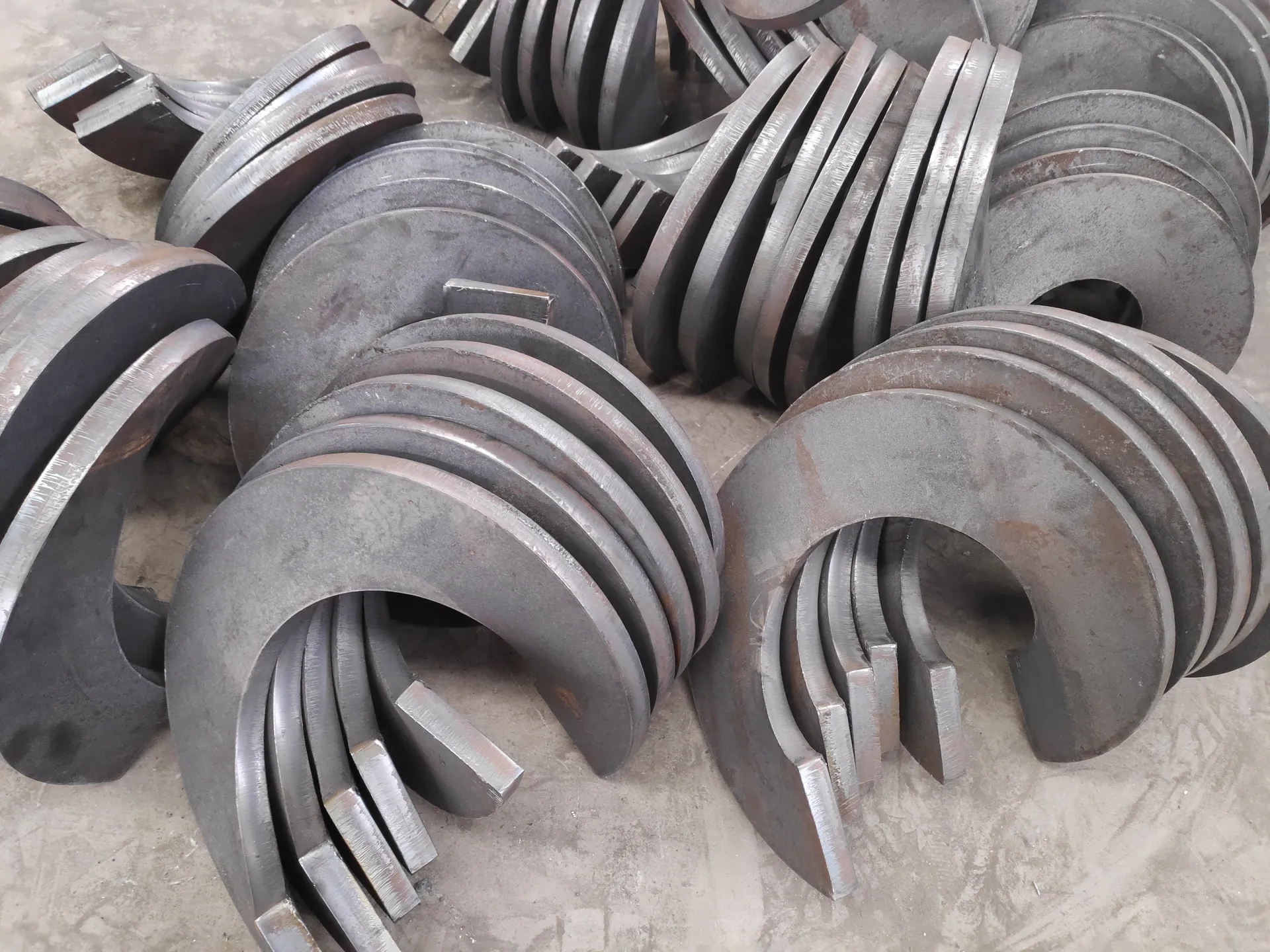
Sectional flight is formed as individual pitch segments. It is often considered for large diameter, thicker plate, wear-resistant material, stainless steel or special geometry that is less practical on a continuous machine. Segments can then be assembled and welded according to the shaft design.
Choose this route for review when:
- Diameter or thickness is outside the intended continuous range
- Individual replacement or assembly segments are needed
- The design includes variable diameter, variable pitch, gaps or special edge features
- Plate grade and joint preparation need individual control
Material and duty can change the answer
Carbon steel, stainless steel, alloy and wear-resistant grades do not form or operate identically. Also describe abrasion, corrosion, temperature, cleaning, impact and whether the flight runs in a tube, trough, mixer or exposed assembly.
Send a useful request package
Include the drawing, material designation, quantity, application, operating notes and photographs of the existing part or installation. If some values are unknown, label them as unknown rather than estimating. The final route is confirmed against the combined requirement.
Continue to Screw Flight products or request a drawing review.